Montgomery County Dog Registration Information
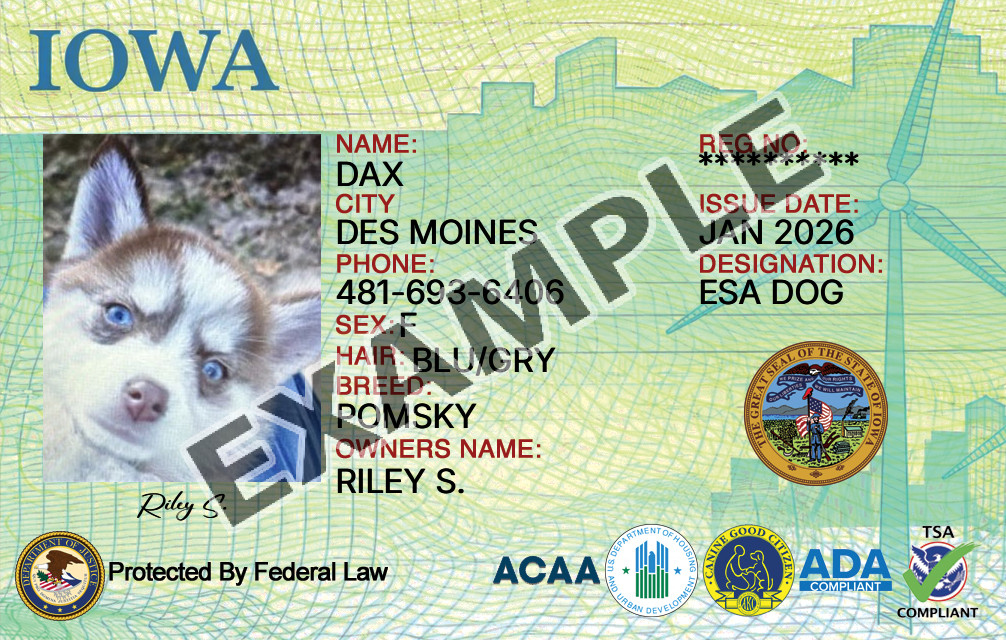
Service Dogs and Emotional Support Animals in Montgomery, Iowa
If you’re asking, “where do I register my dog in Montgomery County, Iowa for my service dog or emotional support dog,” the key point is that there are two different concepts at play: (1) local dog licensing (a city or county requirement tied to rabies vaccination and identification), and (2) a dog’s role as a service dog or an emotional support animal (ESA), which is governed by different laws and does not come from one universal federal registry.
This page explains how a dog license in Montgomery County, Iowa typically works, which local offices commonly handle licensing and animal-control-related questions, and what to expect if your dog is a service dog or emotional support animal. Because requirements can vary by city, this page also clarifies what to do if you live inside city limits (for example, Red Oak) versus in the unincorporated parts of the county.
Where to Register or License Your Dog in Montgomery County, Iowa
City of Red Oak – City Hall (Cat/Dog Licenses)
Montgomery County Sheriff’s Office (Animal-related enforcement & county contact)
Overview of Dog Licensing in Montgomery County, Iowa
What “registering your dog” usually means locally
In many Iowa communities, “registering” a dog is the same thing as purchasing a local dog license. A dog license is generally a local identification system that helps animal control and law enforcement return lost dogs, confirm rabies vaccination compliance, and support enforcement when dogs are running at large or involved in complaints. People also search phrases like animal control dog license Montgomery County, Iowa when they’re trying to find the right government office to contact for licensing, tags, and local rules.
County vs. city rules (why your exact address matters)
Montgomery County includes both incorporated cities and unincorporated (rural) areas. In incorporated cities, licensing and animal ordinances are often handled by the city (for example, Red Oak indicates cat/dog licenses are handled at City Hall). In rural parts of the county, animal-related enforcement and direction are often handled through county law enforcement. If you’re not sure which applies to you, ask: “Do I live inside city limits?” and then contact the appropriate office listed above.
Service dogs and ESAs: how they relate to local licensing
Even if your dog is a service dog or an emotional support animal, you may still need to comply with local licensing and vaccination rules. Those local requirements are different from whether your dog qualifies as a service dog (under disability law) or as an ESA (typically supported by documentation for certain housing contexts).
What You Need Before Registering a Dog
Common documents and information requested
While details can vary by municipality, most places that issue a dog license in Montgomery County, Iowa will ask for some combination of the following. If you bring these items, you can usually complete your registration more quickly.
- Rabies vaccination proof (often a certificate signed by a veterinarian)
- Owner contact details (name, address, phone)
- Dog details (name, breed or mix, color/markings, sex, age)
- Spay/neuter documentation (if the local fee schedule differs)
- Payment for any applicable license fee
Rabies vaccination: a frequent baseline requirement
Local dog licensing commonly requires proof of current rabies vaccination. For example, Red Oak’s ordinance states that before a license is issued, the owner must present evidence that the dog or cat has been vaccinated against rabies, and it describes the vaccination certificate requirement.
Steps to Register or License a Dog in Montgomery County, Iowa
Step 1: Confirm who issues the license for your address
- If you live in Red Oak city limits, start with City of Red Oak – City Hall for cat/dog licenses.
- If you live outside city limits or you are unsure which city office applies, call the Montgomery County Sheriff’s Office and ask who issues dog licenses for your location.
Step 2: Gather required proof (especially rabies vaccination)
Have your rabies certificate ready. If your dog’s vaccination is due soon, consider updating it first so your proof is current for the licensing period.
Step 3: Apply and pay any required fee (if applicable)
Many licensing systems require a completed form and payment. Fee schedules can vary by city and may depend on whether your dog is spayed/neutered, age, or other local categories. If you are licensing in Red Oak, the city code indicates the annual fee is set by the city’s current fee schedule.
Step 4: Keep the tag accessible
If your license includes a tag number, keep it with your records and follow the local rule for displaying tags on your dog’s collar/harness when appropriate. This is especially helpful if your dog is found loose and needs to be quickly identified.
Service Dog Laws in Montgomery County, Iowa
No universal federal “registration” for service dogs
A service dog’s legal status is not created by purchasing an ID card online or adding your dog to a single national database. Under U.S. disability law concepts, a service dog is generally a dog that is individually trained to do work or perform tasks for a person with a disability. That status comes from the dog’s training and function, not from a government-issued “service dog registration” number.
Licensing is separate from service dog status
Local licensing (for example, a city-issued dog license) is usually about rabies vaccination and local identification. A service dog may still need a local license if local rules require it. If you want the most accurate answer for your address, ask the licensing office whether service dogs receive any local fee exemption or special handling; do not assume exemptions exist unless the local office confirms.
| Category | What it is | Typical legal basis | “Registration” reality | Local dog license impact |
|---|---|---|---|---|
| Dog license | Local license/tag system tied to local ordinances (often for identification and rabies compliance). | City or county ordinance requirements. | No special “federal registry”; licensing is handled locally where required. | May be required regardless of whether the dog is a pet, a service dog, or an ESA. |
| Service dog | Dog individually trained to perform tasks/work for a person with a disability. | Disability access rules (public access) and related state/local enforcement. | No single universal federal government registration. Status is based on training and function. | Often still subject to local licensing and vaccination rules (confirm any local exemptions). |
| Emotional support animal (ESA) | Animal that provides emotional support; not required to be task-trained as a service dog. | Typically relevant to housing accommodations with appropriate documentation. | No single universal federal government registration. “ESA letters” are documentation, not a government registry. | Usually still subject to local licensing and rabies vaccination rules where applicable. |
Emotional Support Animal Rules in Montgomery County, Iowa
What an ESA is (and is not)
An emotional support animal (ESA) generally refers to an animal that provides comfort or support that can help with a person’s mental or emotional health symptoms. ESAs are commonly discussed in the context of housing accommodations. Unlike service dogs, ESAs are typically not defined by task training, and they do not automatically have the same public access rights as service dogs.
Local licensing still applies
If your ESA is a dog, you should still plan to follow local dog licensing requirements in Montgomery County, Iowa (city rules if you live in a city; county direction if you live in an unincorporated area). When in doubt about where to register a dog in Montgomery County, Iowa, start with the offices listed above and ask what applies to your exact address.
Frequently Asked Questions
Where do I register my dog in Montgomery County, Iowa?
It depends on where you live. If you live in Red Oak city limits, City Hall lists cat/dog licenses as a service and is a primary place to start. If you live in a different city or outside city limits, contact the Montgomery County Sheriff’s Office to confirm the correct licensing authority for your address.
Do I need a dog license if my dog is a service dog?
Often, yes—because licensing is usually separate from a dog’s service status. Local licensing requirements typically focus on identification and rabies vaccination. Ask the local licensing office whether any fee exemption applies to service dogs for your municipality.
Do I need a dog license if my dog is an emotional support animal (ESA)?
In many communities, yes. ESA status generally does not replace local licensing requirements. You should still be prepared to show proof of rabies vaccination when licensing is required locally.
What proof do I usually need to get a dog license?
The most common requirement is proof of current rabies vaccination. Some offices also ask for identification, proof of residency, and spay/neuter documentation if it affects the fee.
What if I’m not sure whether my address is inside city limits?
Call the Montgomery County Sheriff’s Office and ask which local office handles dog licensing for your address. This is a practical way to avoid applying to the wrong place, especially if you live near a city boundary.
Register A Dog In Other Iowa Counties
Select your county below to get started with your dog’s ID card. Requirements and license designs may vary by county, so choose your location to see the correct options and complete your pup’s registration.
- Adair Dog License Cards
- Adams Dog License Cards
- Allamakee Dog License Cards
- Appanoose Dog License Cards
- Audubon Dog License Cards
- Benton Dog License Cards
- Black Hawk Dog License Cards
- Boone Dog License Cards
- Bremer Dog License Cards
- Buchanan Dog License Cards
- Buena Vista Dog License Cards
- Butler Dog License Cards
- Calhoun Dog License Cards
- Carroll Dog License Cards
- Cass Dog License Cards
- Cedar Dog License Cards
- Cerro Gordo Dog License Cards
- Cherokee Dog License Cards
- Chickasaw Dog License Cards
- Clarke Dog License Cards
- Clay Dog License Cards
- Clayton Dog License Cards
- Clinton Dog License Cards
- Crawford Dog License Cards
- Dallas Dog License Cards
- Davis Dog License Cards
- Decatur Dog License Cards
- Delaware Dog License Cards
- Des Moines Dog License Cards
- Dickinson Dog License Cards
- Dubuque Dog License Cards
- Emmet Dog License Cards
- Fayette Dog License Cards
- Floyd Dog License Cards
- Franklin Dog License Cards
- Fremont Dog License Cards
- Greene Dog License Cards
- Grundy Dog License Cards
- Guthrie Dog License Cards
- Hamilton Dog License Cards
- Hancock Dog License Cards
- Hardin Dog License Cards
- Harrison Dog License Cards
- Henry Dog License Cards
- Howard Dog License Cards
- Humboldt Dog License Cards
- Ida Dog License Cards
- Iowa Dog License Cards
- Jackson Dog License Cards
- Jasper Dog License Cards
- Jefferson Dog License Cards
- Johnson Dog License Cards
- Jones Dog License Cards
- Keokuk Dog License Cards
- Kossuth Dog License Cards
- Lee Dog License Cards
- Linn Dog License Cards
- Louisa Dog License Cards
- Lucas Dog License Cards
- Lyon Dog License Cards
- Madison Dog License Cards
- Mahaska Dog License Cards
- Marion Dog License Cards
- Marshall Dog License Cards
- Mills Dog License Cards
- Mitchell Dog License Cards
- Monona Dog License Cards
- Monroe Dog License Cards
- Muscatine Dog License Cards
- O'Brien Dog License Cards
- Osceola Dog License Cards
- Page Dog License Cards
- Palo Alto Dog License Cards
- Plymouth Dog License Cards
- Pocahontas Dog License Cards
- Polk Dog License Cards
- Pottawattamie Dog License Cards
- Poweshiek Dog License Cards
- Ringgold Dog License Cards
- Sac Dog License Cards
- Scott Dog License Cards
- Shelby Dog License Cards
- Sioux Dog License Cards
- Story Dog License Cards
- Tama Dog License Cards
- Taylor Dog License Cards
- Union Dog License Cards
- Van Buren Dog License Cards
- Wapello Dog License Cards
- Warren Dog License Cards
- Washington Dog License Cards
- Wayne Dog License Cards
- Webster Dog License Cards
- Winnebago Dog License Cards
- Winneshiek Dog License Cards
- Woodbury Dog License Cards
- Worth Dog License Cards
- Wright Dog License Cards
